Why the Government’s Autumn 2026–Spring 2027 legislative programme demands more than routine monitoring
Now that the Conference season is over, now the real political work starts.
Heads of Communications, External Affairs, Public Affairs and Government Relations are returning to one of the most demanding legislative programmes in recent years.
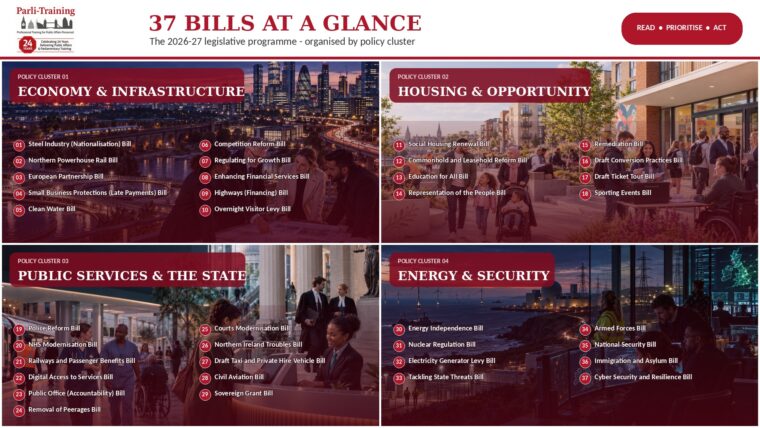
The 2026 King’s Speech announced 37 major bills and draft bills covering economic regulation, infrastructure, energy, housing, education, health, immigration, policing, national security and constitutional reform. The programme is intended to reshape public services, strengthen national resilience and introduce significant economic and regulatory changes.
For trade associations, charities, businesses, professional bodies, campaign groups and public-service organisations, the scale of the programme presents an immediate question:
Which of these bills could affect your organisation—and does your team have the capability to influence what happens next?
The 37-bill challenge
The Government’s programme reaches across almost every major area of public policy.
Economic security, business and infrastructure
Steel Industry (Nationalisation) Bill • Northern Powerhouse Rail Bill • European Partnership Bill • Small Business Protections (Late Payments) Bill • Clean Water Bill • Competition Reform Bill • Regulating for Growth Bill • Enhancing Financial Services Bill • Highways (Financing) Bill • Overnight Visitor Levy Bill
Housing, education, opportunity and political participation
Social Housing Renewal Bill • Commonhold and Leasehold Reform Bill • Education for All Bill • Representation of the People Bill • Remediation Bill • Draft Conversion Practices Bill • Draft Ticket Tout Bill • Sporting Events Bill
Public services and reform of the state
Police Reform Bill • NHS Modernisation Bill • Railways and Passenger Benefits Bill • Digital Access to Services Bill • Public Office (Accountability) Bill • Removal of Peerages Bill • Courts Modernisation Bill • Northern Ireland Troubles Bill • Draft Taxi and Private Hire Vehicle Bill • Civil Aviation Bill • Sovereign Grant Bill
Energy, defence and national security
Energy Independence Bill • Nuclear Regulation Bill • Electricity Generator Levy Bill • Tackling State Threats Bill • Armed Forces Bill • National Security Bill • Immigration and Asylum Bill • Cyber Security and Resilience Bill
This is not simply a long parliamentary timetable.
It is a programme containing measures that could alter regulatory duties, commercial relationships, public funding, enforcement powers, infrastructure investment, professional standards and the delivery of essential services.
Some organisations will be affected by one bill. Others will find their interests spread across several measures progressing simultaneously.
That creates a substantial strategic challenge.
Monitoring legislation is not the same as influencing it
It is relatively easy to follow a bill through Parliament. The stages are published, debates can be watched and amendments can be downloaded.
Influencing the outcome is much harder.
Effective legislative influence depends on understanding:
- where the real decisions are being made;
- when ministers and officials may still be persuaded;
- which MPs, Peers, committees and parliamentary staff matter;
- how to translate organisational concerns into workable solutions;
- when an amendment would advance the campaign;
- how evidence, communications and political pressure should work together;
- and when to negotiate, escalate, compromise or oppose.
Timing is critical.
By the time a bill reaches its most visible parliamentary stages, many of the important policy decisions may already have been made. Opportunities to influence its direction can narrow rapidly as the Government secures political agreement, completes drafting and moves towards implementation.
Organisations therefore need more than good contacts and effective communications.
They need parliamentary understanding, procedural capability and political judgement.
Three capabilities every effective public-affairs team needs
To help organisations respond to this exceptional agenda, Parli-Training is delivering three advanced courses during October.
Together, they provide a complete legislative-influencing pathway:
Understand the process. Develop the political strategy. Change the legislative text.
Passage of a Bill – A Ministerial Perspective
Wednesday 21 October 2026 | £675 + VAT
How does a government proposal travel from a policy idea to the statute book—and where can an external organisation exert meaningful influence?
Drawing on former ministerial experience, this course examines the decisions, negotiations and political calculations behind the formal parliamentary stages.
Participants will learn how to identify the strongest intervention points, engage effectively with departments and bill teams, anticipate political obstacles and maintain influence from policy development through to implementation.
Advanced Political Lobbying – How to Tackle Difficult Legislation
Thursday 22 October 2026 | £685 + VAT
What should an organisation do when proposed legislation threatens its sector, members, reputation or policy objectives?
This advanced course examines the campaigning strategies available when quiet engagement is not enough.
Participants will explore how to identify the political vulnerabilities of a bill, expose unintended consequences, build coalitions, mobilise parliamentary support and apply communications, evidence and political pressure effectively.
It is practical, assertive training for professionals who may need to oppose, delay or substantially reshape damaging legislation.
Advanced Parliamentary Procedure – How to Make Amendments to Bills
Friday 30 October 2026 | £695 + VAT
It is one thing to ask Parliament to change a bill. It is another to give MPs and Peers a credible amendment that can be tabled, debated and defended.
Led by experienced former parliamentary clerks, this specialist course develops the practical capability needed to influence the wording of legislation.
Participants will learn how to translate a policy objective into a potential amendment, understand parliamentary drafting conventions, work within the scope of a bill and prepare the supporting briefings and arguments parliamentarians need.
Capability cannot be built in the middle of a crisis
When difficult legislation appears, organisations frequently discover that too much responsibility rests with too few people.
One colleague may understand the policy. Another may manage political relationships. A communications team may be preparing the public narrative. External lawyers may advise on the text.
But unless those functions are connected by a coherent legislative strategy, opportunities can be missed.
A strong legislative-influencing team must be able to understand the bill, read the political environment, recognise procedural opportunities and present credible solutions.
That capability needs to be developed before the decisive stage of a campaign—not after it has passed.
Expert-led and immediately applicable
Parli-Training’s courses are delivered by former ministers, former parliamentary clerks and experienced political and public-affairs practitioners.
The training goes beyond textbook explanations. Participants examine how influence works in practice and leave with approaches they can apply directly to their organisation’s live legislative priorities.
Places can be booked individually, while organisations may also send colleagues across the three-course programme to strengthen capability throughout their team.
Bespoke in-house training can also be developed around a particular bill, policy area, sector or live legislative campaign.
The legislation is already moving
The 2026–27 parliamentary session is under way, and individual measures are already progressing through Parliament. The decisions taken during the coming months will determine how these proposals are drafted, amended, implemented and ultimately experienced by organisations and their stakeholders.
The central question is not simply whether one of these 37 measures will affect your organisation.
It is whether your organisation will be equipped to help shape what that legislation becomes.
To reserve a place, discuss a multi-course booking or arrange bespoke legislative training, contact Parli-Training.