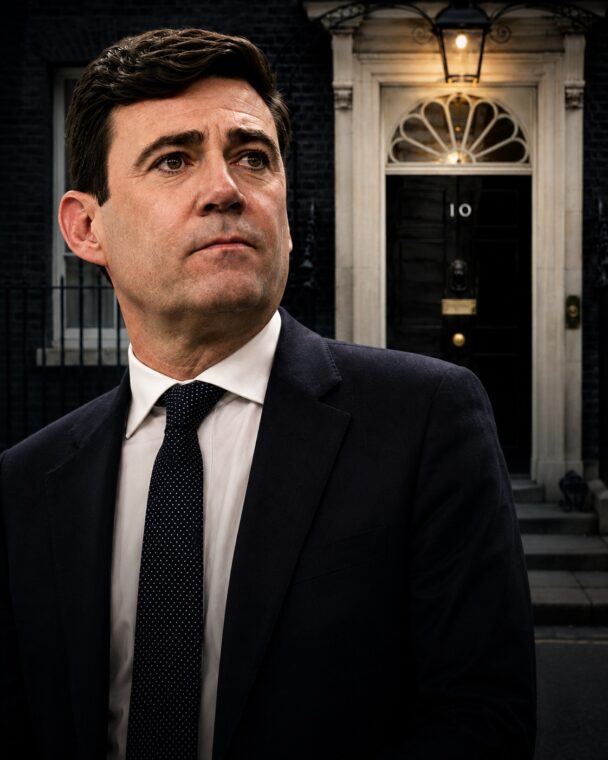
A swift transfer of power
Andy Burnham is on course to become Britain’s next Prime Minister after securing overwhelming support from Labour MPs, in a rapid transfer of power that could reshape both the tone and direction of government.
The former Greater Manchester Mayor and new Makerfield MP has won the backing of 349 Labour MPs. With no rival apparently able to reach the nomination threshold needed to force a contest, Burnham is expected to be confirmed as Labour leader on Friday before entering Downing Street the following Monday.
For Labour, the speed of the transition matters. After a difficult period under Sir Keir Starmer, MPs appear determined to avoid a long and bruising internal contest. Instead, the Parliamentary Labour Party has moved quickly to give Burnham a commanding mandate.
Yet a smooth coronation does not guarantee a smooth premiership. Burnham will inherit a government under pressure on living standards, housing, public services, regional inequality and the cost of essentials. His first challenge will be to turn parliamentary support into a credible programme for government.
A mandate, but no honeymoon
The scale of Burnham’s support allows him to present himself as a unity candidate. That gives him political authority from the start.
However, the country he is preparing to govern is impatient. Voters want visible change. Public services remain strained. Many households still feel squeezed. Meanwhile, councils, mayors and local leaders continue to argue that Whitehall holds too much power and too many resources.
That is the political space Burnham has chosen to occupy.
His pitch is not simply that Labour needs a new leader. It is that Britain needs a different model of government: less centralised, more place-based and more focused on living standards outside the traditional centres of power.
The Burnham operation begins
Attention is now turning to the team that will run his Downing Street operation.
James Purnell, the former Cabinet minister and former Chief Executive of Flint Global, is expected to become Chief of Staff. The appointment would give Burnham a senior No. 10 operator with experience in government, politics and business advisory work.
It also points to the kind of operation Burnham may want to build: politically sharp, policy-heavy and focused on delivery.
Even so, Purnell’s appointment may invite scrutiny. His recent work at Flint Global, a firm that advises major corporate clients, could sit awkwardly with Burnham’s emphasis on accountability, public interest and changing the way power works.
For that reason, the personnel around Burnham will matter. They will not simply manage the diary. They will help define whether his government looks like a genuine break with the past or a reshuffling of familiar Westminster networks.
Josh Simons and the symbolism of Makerfield
Former Makerfield MP Josh Simons is also expected to play a central role in the new administration.
Simons stepped down from the seat to allow Burnham to return to Westminster. That move helped create the route from Greater Manchester to national leadership. Now, reports suggest Simons could become Head of the No. 10 Policy Unit.
If confirmed, that appointment would carry both practical and symbolic weight.
The Policy Unit helps turn political language into workable government policy. Under Burnham, it is likely to focus heavily on devolution, regional growth, housing, utilities, industrial strategy and public service reform.
Makerfield also matters to Burnham’s political story. It represents the kind of post-industrial constituency he wants to place at the centre of government thinking: places that often feel distant from Westminster, but central to the country’s economic and social future.
The centre of government may change
Burnham’s most interesting test may not be who he appoints, but how he chooses to govern.
His political argument rests on the idea that Britain is too centralised. Power sits too heavily in Whitehall. Departments too often work in silos. Local leaders are asked to deliver change without the authority or resources to do so.
That critique points towards a more active centre of government.
Burnham has already promoted the idea of “No. 10 North”, a proposal designed to symbolise his determination to move power closer to regions, towns and communities. Whether it becomes a serious machinery-of-government reform or remains a political emblem will be one of the early tests of his premiership.
If he follows through, the implications could be significant. Metro mayors, councils, combined authorities and local institutions could gain a stronger role in national policy. Whitehall departments may face pressure to work more collaboratively. Regional priorities could move closer to the centre of decision-making.
For Westminster, that would be a cultural shock. For local leaders, it would be the opportunity they have long demanded.
Cabinet choices will send the first signal
The next major test will be the Cabinet.
The Treasury will matter most. Burnham will need a Chancellor who can reassure markets while giving shape to his promise of economic change. The appointment will show how he intends to balance fiscal discipline with his emphasis on growth, housing, public services and living standards.
Other posts will carry their own message.
The Home Office will shape the government’s approach to immigration, asylum and community confidence. Housing will become a major test of delivery. Energy and transport will sit close to any serious agenda on utilities and public control. Business, education and local government will all be central to reindustrialisation, skills and devolution.
In short, the Cabinet will reveal whether Burnham’s rhetoric is matched by political intent.
The policy direction
Burnham enters the leadership with a clear argument: government should work differently, power should move closer to people and places, and economic growth should mean higher living standards across the country.
That agenda is likely to place renewed emphasis on four areas.
Devolution will sit near the centre of the project. Burnham’s record in Greater Manchester gives him a personal stake in shifting power away from Whitehall and towards local leaders.
Housing is likely to move up the list of national priorities. He has repeatedly linked secure housing to health, education, work and public finances.
Essential utilities could become another defining issue. Energy, water, transport and housing may be treated less as ordinary markets and more as foundations of economic security.
Reindustrialisation may also become a central theme. Burnham could connect industrial policy with procurement, technical education, regional growth and sovereign capability.
Taken together, this points towards a more interventionist, place-based and delivery-focused style of Labour government.
What it means for public affairs
A Burnham premiership could change the public affairs map.
For years, many organisations have focused heavily on Westminster and Whitehall. Those routes will still matter. However, they may no longer be enough.
If Burnham’s devolution agenda gains force, organisations will need to engage more seriously with mayors, councils, regional partnerships, local business networks, universities, trade unions and voluntary sector organisations.
The strongest policy arguments may also need to look different.
Instead of simply asking what a proposal does for a sector, organisations may need to show what it does for a place. Does it raise living standards? Does it create good jobs? Does it support regional growth? Does it strengthen public services? Does it offer social value?
That is a more demanding form of public affairs. It requires stronger evidence, deeper local relationships and a better understanding of how policy lands outside London.
A premiership of promise and risk
Burnham starts with a strong mandate from Labour MPs. That gives him room to move, but not endless time.
He must appoint a credible Cabinet, reassure the public, manage Whitehall, hold Labour together and show that his promise of a different kind of government can survive the machinery of the state.
The opportunity is obvious. So are the risks.
If Burnham turns his devolutionary rhetoric into a practical programme, his premiership could mark a significant shift in the way Britain is governed. If departmental resistance, fiscal constraint or internal Labour tensions slow him down, the promise of a new political direction may prove harder to deliver than to announce.
For now, Labour has chosen unity.
The question is what Andy Burnham does with that mandate once he reaches No. 10.