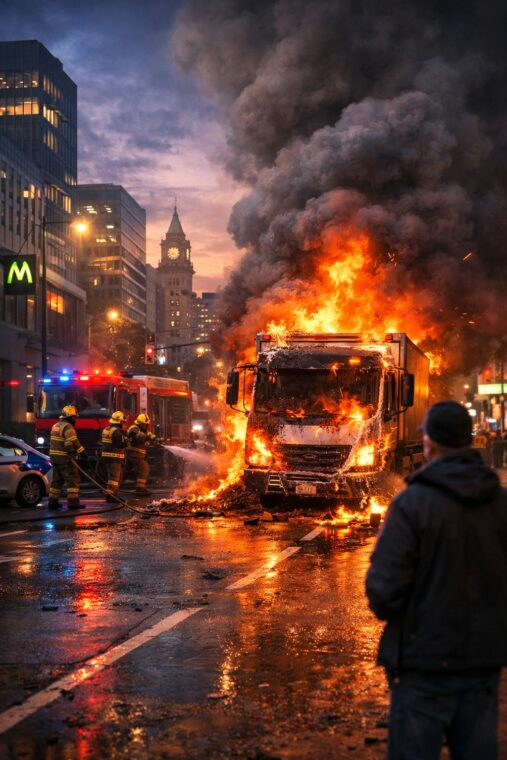
Looking at this dreadful image – this is, perhaps, what “pure cold rage” looks like when it leaves the television studio, the campaign speech and the social media feed, and reaches the street.
In Belfast this week, masked men did not simply protest. They hunted. They moved through area looking for migrant families, black families and ethnic minority residents. They attacked homes, burned cars, smashed windows and forced frightened people to flee.
The phrase daubed nearby said everything: “local homes for local people”. It sounds almost reasonable until you see what it means in practice. In practice, it means terror. It means men deciding that they have the right to identify, punish and expel their neighbours. It means children hiding inside homes while mobs gather outside.
Clare Hanna, the MP for Belfast South and Mid Down, did not hide behind polite language. She described the violence as a “race-based pogrom”. Her words were stark, but they were necessary. When men go door to door looking for “foreigners”, the language of “community tension” becomes an excuse. When families face attack because of their skin colour, name, accent or background, politicians should not reach for soft words.
This Violence Did Not Appear from Nowhere
Some people will try to present Belfast’s violence as spontaneous. They will describe it as anger after a horrific stabbing, or as a local community losing control in a moment of fear. That explanation is too convenient.
The attack that preceded the unrest was appalling. The victim and his family deserve justice, care and peace. However, no crime justifies collective punishment against migrants. No tragedy gives mobs permission to target families who had nothing to do with it.
This violence came from a wider political climate. Over recent years, Britain’s far right has learned how to turn grief into racial anger. A terrible crime happens. Online activists seize on the suspect’s background. Social media accounts strip away context, amplify rumours and turn one incident into a story about national betrayal.
The argument rarely stops at the crime itself. Instead, it becomes a claim that “they” are doing this to “us”. It becomes a story that migrants receive protection while white victims are ignored. It becomes a message that anger is not only understandable, but necessary.
The Language of Rage Has Consequences
That is why Nigel Farage’s language matters. His call for “pure cold rage” after the death of Henry Nowak was not just a passing phrase. It carried political force because it reached an audience already being told that the state has abandoned them.
Rage can play a legitimate role in democratic life. People have every right to feel anger at injustice, violence and institutional failure. But political leaders must understand where they direct that anger. When they repeatedly connect public fear to migration, race and resentment, they cannot pretend surprise when others hear permission.
Farage will no doubt reject any responsibility for the actions of masked men in Belfast. He did not smash the windows. He did not throw the petrol bombs. Yet politics does not only consist of physical acts. It also consists of the messages leaders repeat, the fears they validate and the emotions they choose to inflame.
Words do not need to contain a direct instruction to become dangerous. A public figure can create the mood in which others decide that violence feels justified.
Tommy Robinson and the Online Far Right
Tommy Robinson understands this dynamic very well. His role has never simply been to comment on events. He turns events into recruitment material.
As Belfast faced racist violence, Robinson promoted anti-migrant mobilisation online. He has built much of his public profile by presenting migrants, Muslims and ethnic minorities as threats to Britain. That message now travels faster and further because social media platforms reward outrage.
The platform now called X has made this problem worse. Under Elon Musk, figures once treated as too extreme for mainstream reach have regained vast audiences. Anger has become the product. Fear has become the currency. The more inflammatory the content, the more attention it receives.
A stabbing in Belfast can now become a global spectacle within minutes. A rumour can become a rallying cry. A victim can become a prop in somebody else’s culture war.
This should concern anyone who still takes public order, national security and community cohesion seriously. Britain’s enemies do not need to invent our divisions when they can simply amplify them. Far-right networks now help turn domestic tragedy into political destabilisation.
Mainstream Politicians Have Looked Away
The easiest response for mainstream politicians is to condemn the violence after it happens. Condemnation matters, but it is not enough. The harder task is to confront the politics that prepared the ground.
Conservative leader Kemi Badenoch has recently attacked equality protections and called for the repeal of the Public Sector Equality Duty. She argues that public bodies have placed too much emphasis on institutional racism and not enough on basic competence. She is entitled to argue for legal reform. However, in the current climate, such arguments do not land in a vacuum.
When senior politicians describe equality protections as the enemy of common sense, they help create a mood in which minority rights look like special treatment. That mood does real damage. It tells some people that anti-racism has gone too far, while racist intimidation continues on British streets.
Keir Starmer has taken a clearer line against the violence. His condemnation of the Belfast attacks was necessary and welcome. Yet Labour has also spent too long trying to manage anti-migrant sentiment instead of challenging it.
The government often speaks about migration as a problem to control, deter or apologise for. That language may sound practical in Westminster. Outside Westminster, it can feed a much darker story. It can suggest that migrants themselves are the crisis, rather than human beings caught inside one.
When Does Rhetoric Become Incitement?
The central question now is not only whether this language is ugly or irresponsible. It is whether some rhetoric crosses the line into incitement.
That question should not disappear because the speaker is famous, elected or powerful. The law cannot mean one thing for a frightened man posting racist threats from his bedroom and another for a politician with a microphone, a campaign machine and millions of followers.
Of course, politicians must remain free to criticise immigration policy. They must be able to challenge policing, government failure and public institutions. Free speech matters. Robust democratic debate matters.
But free speech does not give anyone a right to create the conditions for racial violence. When public figures direct public fury at migrants, asylum seekers or ethnic minority communities, and when mobs then target those same groups, the question of criminal liability should at least be asked.
Being elected should not place anyone above the law. Parliamentary privilege protects speech in Parliament. It does not provide a licence to stir up hatred outside Parliament. A democratic mandate should never become a shield for dangerous racial agitation.
If an MP, councillor, party leader, broadcaster or online activist uses words that appear intended, or likely, to encourage racist violence, the authorities should investigate. Where prosecutors believe the legal test has been met, prosecution should follow.
Anything less creates a two-tier system of accountability: punishment for the foot soldiers, impunity for the people who helped light the match.
Belfast Shows Where This Road Leads
Belfast should now serve as a warning, not an aberration. Britain is not immune to pogrom politics. Northern Ireland is not immune. No city remains safe when political leaders cultivate fear, when lies travel faster than facts and when racial resentment receives clicks, votes and television bookings.
The people targeted in Belfast were not symbols in an immigration debate. They were families. Workers. Children. Neighbours. They had every right to expect protection from the police, the state and the political class.
Instead, they found themselves at the sharp end of a politics that has grown bolder because too many people refused to confront it. The far right has spent years telling supporters that migrants are invaders, equality is oppression, anger is courage and violence is merely the language of the unheard.
Now the windows are broken. Homes have burned. Families are frightened. And some of the people who helped heat the atmosphere will insist that they only asked questions.
But there is a direct line between the rhetoric of “pure cold rage” and the sight of masked men roaming Belfast streets. There is a direct line between treating migrants as a threat and watching migrant families run from their homes. There is a direct line between mainstream cowardice and far-right confidence.
The question now is whether Britain’s political leaders will break that line, or whether they will wait for the next city to burn before admitting that rage has consequences.