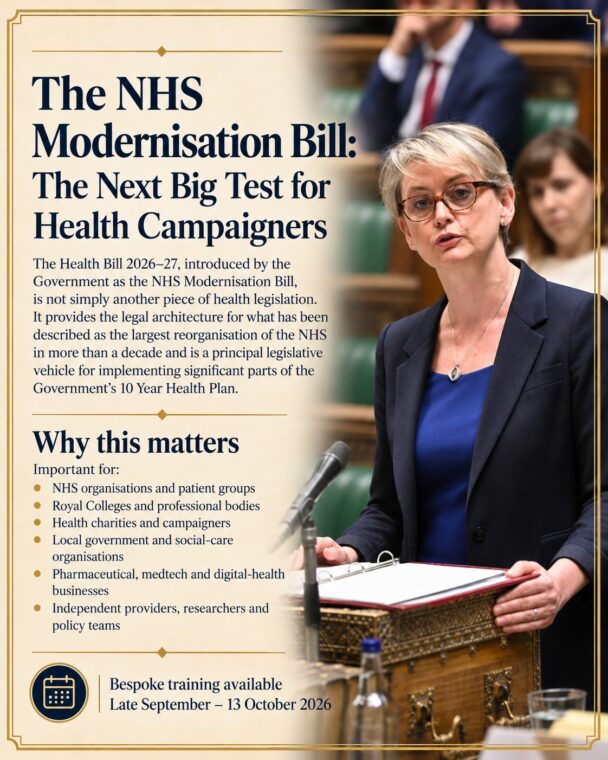
The Health Bill 2026–27, introduced by the Government as the NHS Modernisation Bill, is not simply another piece of health legislation.
It provides the legal architecture for what has been described as the largest reorganisation of the NHS in more than a decade and is a principal legislative vehicle for implementing significant parts of the Government’s 10 Year Health Plan.
For organisations whose work depends on the way the health service is commissioned, regulated, managed or held accountable, that makes the Bill unusually important.
It matters directly to NHS organisations and patient groups, but its consequences extend much further: to Royal Colleges and professional bodies; health charities and campaigners; local government; social-care organisations; trade associations; pharmaceutical and life-sciences businesses; medtech and digital-health companies; independent providers; researchers; and organisations whose policy objectives depend on how the NHS operates.
For public affairs and policy teams across this wider health lobby, the strategic question is therefore changing.
It is no longer simply:
“What does our organisation think about the Bill?”
It is becoming:
“Which parts of the Bill matter to us, what can still be changed, and what is the most effective route for securing that change?”
That is a much more demanding question.
What is the Bill actually trying to change?
At the heart of the legislation is the proposed abolition of NHS England, with functions moving either into the Department of Health and Social Care or elsewhere within the NHS system.
The Government’s stated case is that this should reduce bureaucracy, simplify accountability, enable more local decision-making and move resources towards frontline services. But the Bill goes considerably further than abolishing one organisation.
It also provides for significant changes involving:
the powers of the Secretary of State, including greater influence over commissioning, performance and resources;
Integrated Care Boards, their responsibilities, accountability and place within the NHS structure;
the Single Patient Record and health-data arrangements;
patient voice, including the abolition of Healthwatch and the creation of replacement arrangements;
patient safety and regulation, including structural changes affecting the Health Services Safety Investigations Body and the Care Quality Commission;
and wider changes to NHS organisational governance.
This matters because legislation of this kind does not merely reorganise a departmental chart.
It determines where power sits.
It helps determine who can make decisions, who can challenge them, what duties organisations carry, how accountability works and which decisions will subsequently be made through regulations, guidance or administrative action.
For a public affairs team, those distinctions are fundamental.
The centralisation–devolution tension
One of the most interesting strategic questions within the Bill is the balance between central political control and local autonomy.
Removing NHS England potentially makes accountability simpler: instead of Ministers being able to attribute decisions to an arm’s-length organisation, more responsibility sits directly within DHSC and ultimately with the Secretary of State.
But there is another side to that argument.
The King’s Fund has warned that greater Secretary of State powers could produce over-centralisation, create decision-making bottlenecks and reduce the ability of local systems to adapt to local circumstances. It has called for clearer lines of accountability and proportionate safeguards around the additional powers being transferred to Ministers.
That tension has become particularly interesting politically because Yvette Cooper became Secretary of State for Health and Social Care on 20 July 2026. A change of Secretary of State does not rewrite the Bill, but it does alter the political environment in which the legislation is being taken forward: ministerial priorities, relationships, advisers and the arguments most likely to resonate all need to be reassessed by serious public affairs teams.
This is exactly why legislative lobbying cannot be reduced to submitting amendments.
Policy teams need to understand both the text of the Bill and the politics around the Bill.
The Integrated Care Board question
The future of Integrated Care Boards is another area with implications extending well beyond NHS management.
Under the reforms, ICBs are expected to become stronger strategic commissioners while becoming directly accountable to DHSC rather than NHS England. The legislation also changes elements of their governance and relationship with local systems.
For public affairs professionals, this raises several practical questions.
If commissioning power moves, does your stakeholder map need to move with it?
If a responsibility previously associated with NHS England transfers to DHSC, an ICB or another body, are you still lobbying the right institution?
And if Ministers become more directly accountable for certain decisions, does an issue that was previously largely technical become more politically contestable?
The Health and Social Care Committee has itself highlighted concerns about local-government involvement, mental health, prevention and health inequalities, demonstrating that the Bill’s parliamentary debate already extends beyond the narrow question of organisational restructuring.
Patient voice could become a major Lords issue
The abolition of Healthwatch England and local Healthwatch arrangements creates an obvious area of contention.
The Government intends new patient-voice arrangements, but organisations concerned with patient representation will inevitably ask what is gained or lost when an independent statutory structure is removed.
The King’s Fund has identified patient voice as one of its five central tests for the legislation and warned that abolition could sit uneasily beside the Government’s stated ambition to give patients greater influence over their care.
That creates an important lesson for campaigning organisations.
The most effective objective may not necessarily be:
“Stop this clause.”
It might instead be:
“Secure a statutory safeguard.”
Or:
“Require consultation.”
Or:
“Create an accountability mechanism.”
Or even:
“Obtain a Ministerial commitment about how the replacement system will operate.”
Those are very different lobbying strategies.
The Single Patient Record shows why organisations should avoid approaching the Bill as simply “for” or “against”
The proposed Single Patient Record illustrates the more sophisticated approach required.
The King’s Fund has described the proposal as potentially one of the Bill’s most transformative elements because better information sharing could improve co-ordination and reduce the repeated fragmentation experienced by patients moving between services.
But even a broadly supported objective creates questions about implementation, data governance, access, accountability and safeguards.
For patient organisations, technology providers, pharmaceutical companies, clinicians, researchers and digital-health businesses, the relevant public-affairs question may therefore be less about whether the concept should exist and more about how it will work, who will control it and what later regulations or guidance will determine.
This distinction matters because the answer dictates the lobbying route.
Not everything organisations want belongs on the face of an Act of Parliament.
The mistake of assuming every objective requires an amendment
One of the most common errors in legislative public affairs is treating an amendment as the ultimate measure of success.
Sometimes it is.
But sometimes the more realistic prize is a probing amendment that forces the Minister to explain the Government’s position.
Sometimes it is a concession announced from the Despatch Box.
Sometimes it is an undertaking to consult.
Sometimes it is language subsequently placed in statutory guidance.
Sometimes the critical opportunity comes through regulations made under powers in the Bill.
And sometimes the best strategy is to establish an issue politically during passage so that it shapes implementation after Royal Assent.
The Health Bill itself contains delegated powers that will allow Ministers or other bodies to make further legislation without requiring another full Bill. That means sophisticated influencing strategies need to look beyond Royal Assent, not stop at it.
Why the Lords changes the strategic calculation
The move from the Commons into the Lords is therefore not simply another box on the parliamentary flow chart.
It changes the influencing environment.
At Lords Committee Stage, the Bill receives detailed, line-by-line consideration. Any member of the House of Lords can participate, amendments can be discussed in detail, and—unlike a programmed Commons Bill Committee—the Government cannot impose the same type of guillotine on the subjects under discussion.
Report Stage then provides another opportunity for Peers to examine and amend the Bill, while even Third Reading in the Lords retains a more limited capacity for amendment.
For a health organisation, that opens a fresh set of strategic questions:
- What is the precise outcome we are trying to secure? “Improve the Bill” is not an objective. A strong influencing objective should identify a specific legal, policy, regulatory or implementation outcome.
- Does the objective actually require primary legislation? If not, an amendment may be a negotiating device rather than the final destination.
- Which Peers have the expertise, credibility and interest to advance the issue? A long stakeholder list is less useful than knowing who can table, champion, negotiate, provide expertise or create political pressure.
- What does Government need in order to say yes? An argument can be morally compelling but administratively impossible. Policy teams should anticipate cost, operational, legal and political objections before approaching Ministers.
- What is your negotiating position? Know the ideal outcome, the acceptable compromise and the minimum useful commitment.
- What happens after the intervention? A parliamentary question, amendment or meeting should form part of a sequence—not become the end of the campaign.
The scale of stakeholder interest is already clear
The Commons Public Bill Committee received 146 written evidence submissions, including evidence from providers, professional and regulatory organisations and other stakeholders across the health system.
That should tell public affairs teams something important.
There will be competition for attention.
Ministers, advisers, officials, MPs and Peers will receive many arguments from organisations that consider their issue important.
Having evidence is therefore not enough.
The stronger organisation will usually be the one that can answer five things quickly:
What is the problem? What exactly do you want changed? Why does it matter now? Why is your proposed solution workable? And what action do you want this particular decision-maker to take?
From Bill knowledge to strategic readiness
This is also why organisations should distinguish between a Bill briefing and Bill influencing preparation.
A briefing tells the team what the legislation says.
Strategic preparation asks what the organisation is going to do about it.
The latter requires parliamentary knowledge, but also stakeholder analysis, political judgement, message development, negotiation strategy and an understanding of what happens inside government when lobbying reaches a Minister’s desk.
For organisations with serious interests in the NHS Modernisation Bill, the next few weeks offer an unusually useful opportunity to bring policy and public affairs colleagues together around their actual live objectives.
A strong team exercise should finish with something resembling:
Policy objective → legislative or policy route → target → argument → intervention → timing → follow-up.
That turns legislative knowledge into a campaign.
A rare opportunity to pressure-test the strategy from the Ministerial side of the table
Parli-training is therefore offering bespoke NHS Modernisation Bill / Health Bill influencing workshops for individual organisations and teams, with programmes designed around their own policy objectives.
The workshops are intended to combine approximately 50% legislative and parliamentary capability-building with 50% strategic application and consultancy.
A particularly valuable element is the opportunity for the workshop to be led by a former Health Minister.
For an experienced public affairs team, the attraction is not simply hearing another explanation of how amendments work. It is the opportunity to test the organisation’s proposed strategy against someone who has been on the receiving end of lobbying, parliamentary pressure and stakeholder demands inside the health department.
What would attract Ministerial attention?
What would officials need before recommending a concession?
Is the proposed amendment genuinely workable?
Is the organisation approaching the right person?
Would a commitment, regulation or implementation route offer a better prospect of success?
Where is the argument vulnerable?
These are strategic questions. And answering them before approaching Parliament can save significant time and improve the quality of an organisation’s intervention.
The aim is that the team finishes the day not simply knowing more about the Bill, but knowing what it intends to do next.
NHS Modernisation Bill / Health Bill: Influencing Timeline
| Date / stage | What is happening | Public affairs significance |
| 13 May 2026 | NHS Modernisation Bill announced in the King’s Speech | Beginning of the formal political and stakeholder debate. |
| 14 May 2026 | Health Bill receives Commons First Reading | Bill text enters Parliament; detailed stakeholder analysis begins. |
| 1 June 2026 | Commons Second Reading | MPs debate the Bill’s overall principles; Government secures authority to proceed. |
| 16 June–16 July 2026 | Commons Public Bill Committee | Detailed scrutiny, evidence and amendments. The committee ultimately received 146 written evidence submissions. |
| 7–8 September 2026 | Commons Report Stage activity | Whole House considers amendments and new clauses; divisions took place across both days. |
| September–early October 2026 | Strategic preparation window | Organisations should refine Lords objectives, recruit Peer champions, prepare amendment/briefing material, anticipate Government objections and build coalitions. |
| 13 October 2026 | House of Lords Second Reading scheduled | Major debate on the Bill’s principles and the point at which organisations should ensure priority issues are visible to relevant Peers. The Lords Library notes that future business can be provisional. |
| After Second Reading – dates TBC | Lords Committee Stage | Detailed line-by-line scrutiny. Any Peer may participate; a key opportunity for amendments, probing amendments and Ministerial responses. |
| Later – dates TBC | Lords Report Stage | Further opportunity to test and vote on changes, often an important point for issues developed during Committee. |
| Later – date TBC | Lords Third Reading | Final Lords consideration; some amendments remain possible. |
| After Lords passage | Consideration of Lords Amendments / “ping-pong” | Commons and Lords must agree the final wording. Organisations may need to defend Lords gains or broker compromises. |
| Royal Assent | Bill becomes law | Influencing moves increasingly towards regulations, guidance, implementation and accountability. |
| By March 2027 – Government objective | Planned abolition/merger of NHS England functions | Subject to parliamentary approval and implementation arrangements. |
| From 2028 – Government ambition | Initial Single Patient Record rollout | Shows why some Health Bill campaigns need an implementation strategy extending well beyond passage of the legislation. |
Bespoke Health Bill Influencing Strategy Workshops
Parli-training can deliver bespoke team workshops in late September and early October, allowing organisations to prepare before the Bill’s scheduled Lords Second Reading.
Programmes can be designed for teams of up to 10 delegates and built around the organisation’s own Health Bill priorities.
For availability, programme design and pricing:
Aimee Andrews – Parli-training
📞 0207 839 9326
📧 Aimee.Andrews@parli-training.co.uk
The Bill tells you what Government proposes to change.
A good public affairs strategy determines what your organisation can still do about it.