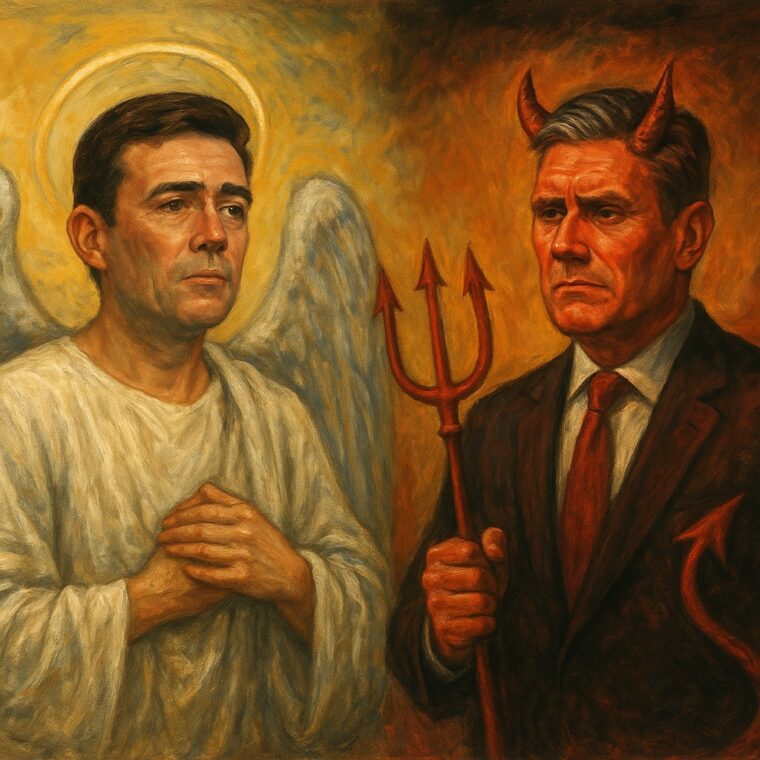
Labour finds itself in turbulent waters. The party that once commanded sweeping support across the country is now grappling with declining personal approval for its leader, multiple scandals, and the rise of Reform UK. Amid these pressures, speculation is growing: can Keir Starmer steady the ship, or is Andy Burnham becoming Labour’s last realistic hope to reconnect with voters and restore credibility?
Starmer’s Charisma Deficit and Public Perception
Keir Starmer’s leadership has long been described as competent but cold. Polls consistently show his personal approval ratings among the lowest of any incoming Prime Minister in modern political history. Ipsos MORI’s September 2025 Political Pulse found only around 20% of voters satisfied with his leadership, while the Independent noted his approval had fallen more steeply than that of Gordon Brown or Tony Blair at comparable stages.
“Starmer is competent, but he struggles to connect emotionally with voters — charisma is not optional in leadership.”
Focus groups echo the numbers. Respondents consistently describe Starmer as “managerial” rather than inspirational. He lacks the charisma and emotional connection that has historically helped leaders resonate with the public. In politics, personality often counts as much as policy, and Starmer’s perceived detachment leaves him vulnerable to both media critique and opposition narratives.
Scandals and Departures Rocking Labour
Labour’s promise to restore integrity following Conservative mismanagement has been dented by high-profile controversies.
Morgan McSweeney and Undisclosed Donations
The campaign director Morgan McSweeney was recently embroiled in a scandal over undisclosed political donations. Critics argue that the episode reinforces a perception of opacity in the party, undermining Labour’s claims of moral renewal and transparency.
Angela Rayner’s Resignation
Angela Rayner, Deputy Prime Minister and a vital link between Labour’s left and centrist wings, resigned in September 2025 after an independent adviser concluded she had underpaid stamp duty and breached the ministerial code. Her departure removes a figure with grassroots credibility and emotional resonance from the Cabinet, leaving the party weaker both internally and in the public eye.
Homelessness Minister Scandal
In August 2025, homelessness minister Rushanara Ali resigned following revelations that she had evicted tenants from her property only to relist it at a higher rent. The incident struck at the heart of Labour’s narrative of fairness and integrity, generating accusations of hypocrisy and further undermining public trust.
Economic Drift and Policy Flashpoints
Labour’s internal difficulties are compounded by economic and social policy concerns.
Chancellor Rachel Reeves has faced criticism for a cautious, orthodox approach to the economy. With inflation lingering and household incomes under pressure, her reluctance to adopt bold, redistributive measures has disappointed both activists and voters. Critics argue that without a more ambitious economic strategy, Labour risks alienating key constituencies.
Policy controversies have also strained trust. Labour’s stance on Gaza has been seen as equivocal, frustrating long-time supporters in affected communities. Simultaneously, Starmer’s refusal to commit to scrapping the two-child benefit cap has provoked criticism from anti-poverty advocates, faith groups, and unions. Together, these issues reflect a leadership perceived as centralised, risk-averse, and disconnected from grassroots concerns.
The Rise of Reform UK
Adding to Labour’s challenges is the ascent of Reform UK. Ipsos MORI polling suggests that Reform is consolidating support among disillusioned Conservative voters, at times matching Labour in head-to-head surveys, with figures such as 38% for Labour versus 35% for Reform. The narrative that Labour is unelectable is amplified by these numbers.
However, this rise is uneven. Reform’s support is concentrated among older demographics, while Labour maintains stronger appeal among younger and urban voters. Many remain undecided, highlighting the volatility and contestability of upcoming elections.
Why Andy Burnham Maybe The Party’s Last Hope for Electoral Success?
Amid these pressures, Andy Burnham’s name increasingly surfaces as a potential saviour. As Mayor of Greater Manchester, Burnham has built a reputation for competence and authenticity. He led high-profile negotiations with Westminster during COVID-19, implemented reforms in transport and housing, and maintained strong local popularity.
Where Starmer struggles with charisma, Burnham excels. His plain-speaking, relatable approach resonates with voters across the North and among working-class constituencies where Labour has traditionally been strong. Allies argue that Burnham represents a path for Labour to regain both trust and electoral credibility.
Andy Burnham’s Key Political Achievements
- Negotiated funding and restrictions during COVID-19.
- Introduced progressive transport reforms in Greater Manchester.
- Advocated for housing and social care improvements with tangible outcomes.
How Could Burnham Legally Take the Leadership?
A practical question arises: Burnham is no longer an MP. Labour rules currently require the leader to sit in the House of Commons. However, two routes could make his leadership feasible:
- Parliamentary By-Election Route: A sitting Labour MP could step down from a safe seat, allowing Burnham to contest a by-election. Upon winning, he would become eligible to stand for party leadership.
- Rule Change at Labour Conference: Labour could amend its constitution to permit a non-MP, such as a metro mayor, to contest the leadership. While unprecedented, discussions about reforming leadership eligibility have gained traction among activists frustrated with Westminster’s centralisation.
In practice, the by-election route is most realistic. If Starmer’s position deteriorates, internal and public pressure could create the pathway for Burnham’s return and a subsequent leadership bid.
Labour is at a Crossroads
Labour now faces stark choices. It can persist with Starmer’s cautious approach, risking further erosion of public trust. Scandals, resignations, policy missteps, and Starmer’s lack of charisma compound Labour’s challenges. Yet polling data shows that victory is not impossible, particularly if the party recalibrates its strategy and reconnects with core constituencies. Labour is far from irreversibly defeated, but the next year is critical. Starmer’s leadership faces multiple pressures: personal unpopularity, scandal fallout, policy discontent, and Reform UK’s rise. Andy Burnham offers a potential path forward: a leader with charisma, authenticity, and proven governing experience who could bridge the gap between the party and its voters. Whether Labour can navigate this crossroads under Starmer, or must look to Burnham, will define its electoral fortunes for the next decade. The stakes are high, and the decisions made now will reverberate far beyond Westminster.