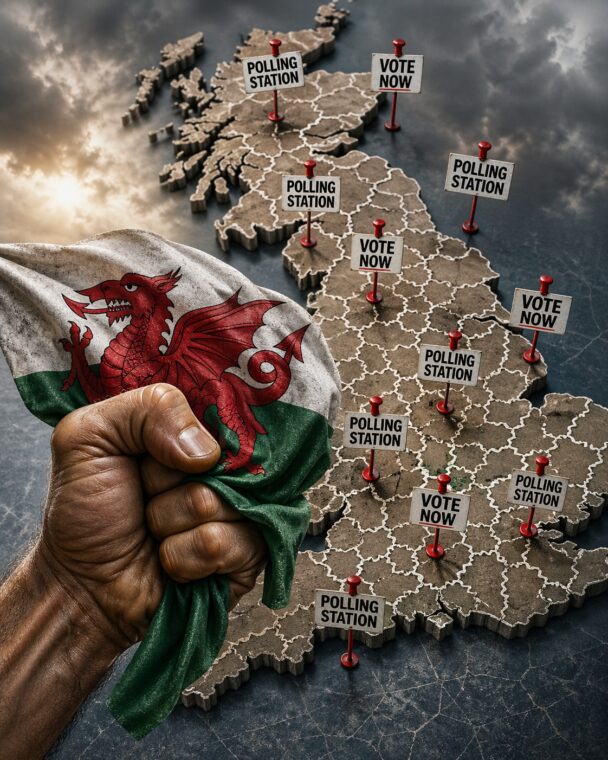
From the rise of Reform UK to the growing strength of the Green Party of England and Wales, the Senedd elections
offer an early signal of the forces that could shape the next UK general election.
The Welsh election 2026 may look like a devolved contest. In reality, it is shaping up as an early signal of what could unfold at the next UK general election in 2029.
In A Christmas Carol, the ghost of Christmas future offers a warning, not a certainty. The same applies here. The Senedd elections are less a prediction than a projection—a glimpse of the political forces already reshaping the UK.
Labour’s dominance faces a real test
For more than two decades, Labour has governed Wales. That record once suggested stability. Now it exposes the party to a different risk: accumulated frustration.
Early polling and projections around the Welsh election results suggest Labour may lose ground. Not necessarily to one rival, but across several fronts. Voters are showing less tolerance for incremental change and more willingness to explore alternatives.
As the UK governing party, Labour faces a similar test in England. The pressures visible in Wales—on public services, delivery and trust—are not confined to devolved politics.
A fragmented map – and a changing result
What makes this election notable is not just who wins, but how the vote is distributed.
The Welsh election results are likely to show fragmentation:
- Plaid Cymru consolidating support among voters seeking stronger Welsh autonomy
- Green Party of England and Wales expanding beyond a niche base, particularly among younger and urban voters
- Reform UK capitalising on disillusionment with mainstream politics
This is not a traditional swing. It is a redistribution of support across multiple parties, each pulling from different parts of Labour’s coalition.
The Greens: from fringe to factor
One of the most significant developments in the Senedd elections is the growing visibility of the Green vote.
The Green Party of England and Wales is no longer operating at the margins. It is building a broader coalition of voters concerned with climate policy, housing, and systemic reform.
In Wales, this growth may not translate into dominance—but it does not need to. Even modest gains can shift outcomes in a fragmented system. More importantly, they signal a wider trend.
In England, the Greens have already begun to convert vote share into parliamentary representation. If that trajectory continues, they could play a more decisive role in shaping electoral outcomes by 2029.
Reform UK and the politics of protest
Alongside the Greens, Reform UK represents a different kind of disruption.
If projections hold and Reform performs strongly in Wales, it will challenge assumptions about where its support can grow. A breakthrough would suggest that its appeal extends beyond English protest voters and into a broader UK-wide electorate.
That possibility alone will influence how parties approach the next UK general election.
A testing ground for what comes next
Welsh elections have long functioned as a political testing ground. The Welsh election 2026 is no exception.
Campaigns are being refined in real time. Parties are testing messages, targeting specific voter groups and adapting to a more fragmented electorate. The lessons learned here—about voter movement, turnout and issue salience—will feed directly into UK-wide strategy.
After the results: consolidation or continued fragmentation
The immediate Welsh election results will matter. But the longer-term impact will depend on what follows.
Will voters begin to consolidate around a smaller number of parties? Or will fragmentation deepen, with support continuing to spread across Labour, Plaid, the Greens and Reform?
If fragmentation holds, it could reshape the electoral map ahead of 2029. Elections would become less about broad national swings and more about targeted, constituency-level competition.
Why politicos should care
Wales is not a perfect mirror of England. Different electoral systems and political traditions still shape outcomes.
But the underlying dynamics are increasingly shared: declining party loyalty, rising voter volatility, and the growth of smaller parties.
That is why the Welsh election 2026 matters. It offers a real-time view of the forces that could define the next UK general election.
Ignore it, and you risk overlooking an early signal of where British politics is heading.