How teams are transforming the way they work
A Shift Already Underway
Across Public Affairs and policy teams, something has shifted.
Artificial intelligence is no longer a distant concept. Instead, it has become part of the working environment. Tools such as Microsoft Copilot, Claude, and Perplexity are now widely available. Some teams experiment cautiously, while others move more quickly.
However, access is no longer the main issue. The real challenge lies in application.
As a result, many teams are now asking a more practical question:
How can A.I support the flow of everyday work?
Not in theory, but in practice — in the middle of a busy week, when briefings must go out, stakeholders need responses, and political developments evolve quickly.
From Theory to Workflow
Earlier this year, one large UK organisation took a different approach.
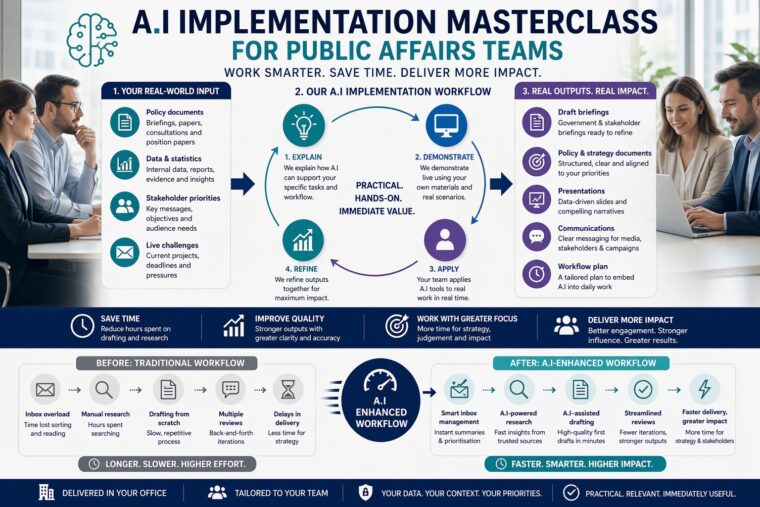
Rather than stepping away from their workload, the team brought it into the session. Emails, draft briefings, policy documents, and internal data all became part of the process. Consequently, the training did not sit alongside their work — it became part of it.
The focus shifted almost immediately. Instead of asking what A.I could do in general terms, the team explored how it could support specific tasks.
In other words, the question changed from what is possible? to what is useful right now?
Where Time Is Really Saved
The most noticeable impact came through time savings.
For example, drafting stakeholder responses became significantly faster. A.I supported the creation of strong first drafts, which could then be refined. Similarly, long email threads no longer slowed decision-making. They were summarised quickly, allowing teams to move directly to action.
In policy work, the benefits were equally clear. Data that once required hours to interpret could be structured into clear narratives far more efficiently. As a result, teams spent less time assembling information and more time refining arguments.
Meanwhile, research processes also changed. Instead of searching across multiple sources, teams generated structured insights and tested them immediately. This shift reduced friction and improved focus.
Better Outputs, Faster
As the session progressed, the quality and speed of outputs improved.
Presentations were developed using internal data, but in less time than usual. Policy documents began with structured drafts rather than blank pages. Communications outputs, including messaging and content, became clearer and more consistent.
Importantly, these examples are not fixed templates. Rather, they demonstrate what becomes possible when A.I is embedded into workflow.
Ultimately, the key difference lies in how quickly teams can now produce high-quality work.
Maintaining Control While Increasing Speed
There is often concern that A.I may reduce control or weaken quality. In practice, the opposite tends to happen.
Because A.I accelerates early-stage work, it allows more time for judgement and strategic thinking. Instead of focusing on drafting, teams can focus on refining and aligning outputs.
Therefore, the human role becomes more focused, not less. A.I supports the process, but decision-making remains firmly with the team.
A Practical Approach to Adoption
One of the most important aspects of this approach is its immediacy.
There is no need for large-scale transformation programmes. Instead, teams work with tools they already have. The emphasis is on integrating A.I into existing workflows in a natural way.
By working within their own environment, teams see immediate relevance. Furthermore, they apply learning in real time, which helps embed new approaches more effectively.
As a result, adoption becomes both faster and more sustainable.
A Changing Way of Working
A.I is not replacing Public Affairs. However, it is changing how the work is delivered.
Teams that see the greatest benefit focus on improving workflow. They remove unnecessary steps, reduce time spent on repetitive tasks, and improve clarity in outputs.
In doing so, they use A.I to support what they already do — but more efficiently.
Find Out More
To find out more about this bespoke A.I Implementation course, or to discuss how it could be tailored to your team, please contact:
Aimee Andrews
📞 0207 839 2982