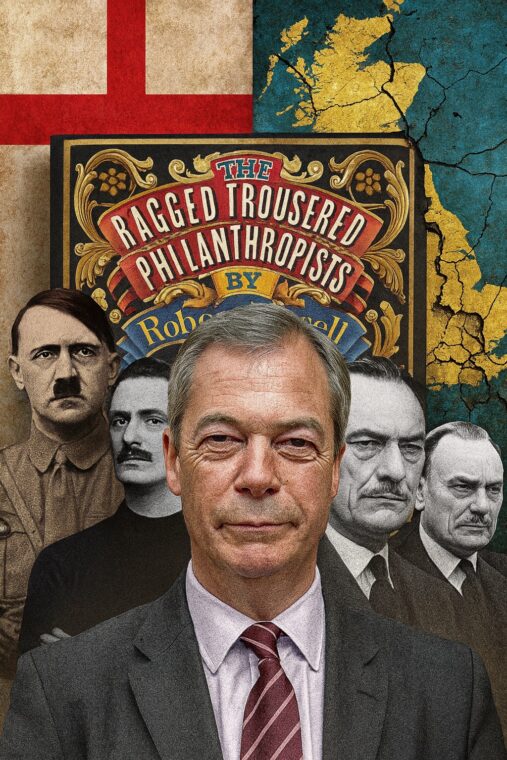
The dark psychology behind the rise of Reform
It is December 2025. Reform UK claims it has become the largest political party in Britain by membership. Figures reported by the Times suggest Labour’s membership has fallen below 250,000, while Reform says it now counts more than 268,000 paid-up members.
Whether those numbers withstand scrutiny almost misses the point. The symbolism matters more. A party positioned on the far right of British politics can plausibly claim mass affiliation at a moment of economic stagnation, institutional fatigue and deep public disillusionment. This shift did not emerge from campaign brilliance or personality politics. It reflects something more predictable: long-running economic decay colliding with a familiar psychological pattern. When societies cannot face their own rot, they go looking for villains.
Projection as a Political Strategy
Reform UK’s appeal does not rest on a novel policy programme. It draws power from a much older psychological mechanism: projection.
In psychological terms, projection occurs when individuals or groups refuse to confront their own wounds, failures or responsibilities and instead export them onto others. People hunt externally what they cannot tolerate internally. That mechanism explains why villain-making works so well in politics.
Villains provide emotional relief. If someone else causes the problem, people do not have to sit with fear, grief or failure. Roots hurt. Confronting causes means acknowledging neglect, poor decisions and lost control. Moral superiority feels safer than honesty. Blame gives chaos a shape. Ambiguity terrifies; villains promise order.
This pattern does not belong to politics alone. It appears wherever people or institutions create spectacle instead of engaging in difficult self-examination. Those who can face decay directly tend to act quietly: they take responsibility, set limits and rebuild. They do not need enemies.
Reform UK does. Its worldview depends on externalisation.
The Psychological Architecture of the Reform Narrative
Viewed through a psychological lens, the Reform story shows a consistent structure.
Projection comes first. Unresolved economic anxiety, loss of status and cultural disorientation move outward. Instead of asking how Britain has changed or how people might adapt, the question becomes simpler: who took this from us?
Avoidance follows. Britain’s malaise stems from globalisation, automation, decades of underinvestment and political mismanagement across governments. These causes implicate elites, institutions and voters alike. Complexity overwhelms a population already under strain. A villain costs less, cognitively and emotionally.
Blame repairs identity. For people who feel humiliated or ignored, blame restores dignity without effort. I am not failing; I have been betrayed. The emotional reward feels real even when the explanation collapses under scrutiny.
Threat produces binaries. Under perceived danger, human cognition simplifies. The world splits into oppositions: us and them, strong and weak, patriots and traitors. This is threat psychology, not careful political reasoning.
Leaders become avatars. Charismatic figures absorb and express anger without restraint. Supporters experience this as relief rather than accuracy: he’s saying what I feel. Emotion discharges. Analysis disappears.
This matters because facts alone cannot dismantle such a structure. Reform’s appeal does not operate primarily at the level of ideology. It functions as emotional regulation through blame.
From Thatcherism to Rot
To understand why this psychology now finds such fertile ground, Britain’s economic story needs plain telling.
Britain’s decline did not happen by accident. It followed logically from an economic model that began under Thatcherism and hardened into entrenched neoliberalism.
Thatcherism reshaped the country in three decisive ways. It financialised the economy, elevating the City over productive industry. It dismantled organised labour without building replacement institutions. It privatised national assets, often cheaply and irreversibly.
Some short-term efficiency gains followed. The strategic failure came later. Britain dismantled its industrial and regional base without constructing a new one. Germany retooled. France protected strategic sectors. Britain sold and hollowed out.
By the 1990s, this approach hardened into cross-party consensus. Markets knew best. The state should remain thin and managerial. Public goods had to justify themselves through narrow value-for-money tests. Growth would come from finance, property and consumption rather than production.
The consequences accumulated steadily: chronic underinvestment in infrastructure, skills and research; regional abandonment beyond London and the south-east; asset inflation instead of wage growth; rent-seeking replacing value creation. Britain did not simply stop making things. It began extracting from itself.
The Economy People Feel in Their Bodies
This history explains why today’s anger feels physical rather than abstract. People experience decline daily: stagnant living standards, insecure work, broken public services, unaffordable housing and, most corrosively, the absence of any believable future.
Neoliberalism also stripped away the language needed to explain this honestly. People retained the feelings but lost the framework. Instead of hearing our economic model is exhausted and extractive, they heard simpler stories: migrants, Brussels, judges, civil servants, elites, “wokeness”.
This is where Reform UK enters. It does not challenge the model. It redirects the anger the model creates.
Immigration as a Psychological Container
In this process, immigration becomes the symbolic container for national decline. Immigrants do not cause Britain’s problems, but political narratives make them represent those problems.
Immigrants remain visible. They lack power to answer back. They sit at the intersection of economic anxiety and cultural fear. Blaming them allows anger without self-implication.
This is classic scapegoat psychology, repeatedly observed in societies experiencing decline they cannot yet face. Anger moves sideways instead of inward. The rot underneath continues untouched.
A Long British Habit of Blame
Britain has followed this pattern for more than a century.
Robert Tressell’s The Ragged Trousered Philanthropists, first published in 1914, described a working class systematically exploited while being encouraged to resent other workers, distrust foreigners and defend the very system impoverishing them. The tragedy was not poverty alone, but false consciousness.
The pattern repeats. Edwardian Britain blamed immigrants and the “undeserving poor”. The interwar years blamed foreigners, Jews and communists. Post-war decline blamed migrants and bureaucrats. Post-neoliberal collapse blames migrants, refugees and elites.
The villains change. The function does not.
What has changed is the depth of decay. In Tressell’s time Britain still produced. Today it largely rents, extracts and financialises. The scapegoat narrative now carries more explanatory weight than it can bear. It is cracking.
Rot, Not Roots
The distinction matters. Roots suggest something buried and formative. Rot implies neglect, corrosion and refusal to repair. Rot spreads when ignored. People sense it even when they lack the language to name it.
Rot demands honesty, maintenance and rebuilding. Villains demand anger, spectacle and blame.
Reform UK offers the latter. It disrupts and inflames, but it cannot build. Building requires patience, accountability and shared ownership. All of these dissolve the villain narrative.
Decline Without Renewal
From the monetarist shock of 1979 and deindustrialisation without replacement, through financial deregulation, privatisation and abandoned industrial strategy; from New Labour’s growth without resilience to the financial crisis that exposed but did not remove the rot; from austerity’s hollowing out of public services to Brexit offering anger without a model; from pandemic emergency Keynesianism to inflation shocks, policy error and prolonged stagnation — Britain has absorbed drift, shock and exhaustion without renewal.
By 2025 the economy has not collapsed. It is exhausted. Households face sustained cost pressures. Businesses hesitate to invest. The state intervenes more but remains fiscally constrained. Productivity still stagnates. The challenge is no longer crisis management. It is reconstruction.
Blame as Emotional Relief
Reform’s appeal does not grow from optimism or transformation. It grows from relief.
After years of decline experienced as personal failure — falling living standards, shrinking status, diminished control — blame becomes psychologically necessary. Structural decay feels abstract and intolerable. Villains feel simple and soothing.
Reform offers a story that converts anxiety into anger and disappointment into moral certainty. It reassures supporters that nothing is wrong with them, or with the country they remember. The fault lies elsewhere: outsiders, elites, imagined saboteurs.
This is not a movement built on hope. It rests on avoidance — a collective refusal to confront how deeply Britain has changed and how complicit its own choices have been in that change.
Finding villains feels easier than facing rot. Rot demands responsibility, grief and acceptance that the past is not coming back.